Who gets to be called a leading lady?
For decades, the title carried a certain mythology. In Philippine cinema and television, the leading lady was often the woman at the center of the story, the face on the poster, the actress audiences lined up to watch. Through unforgettable performances, these women became more than stars. They became part of the country’s cultural memory. There was Nora Aunor as Elsa in Himala, whose faith turned an ordinary barrio woman into one of Philippine cinema’s most enduring heroines, and Rosario in Tatlong Taong Walang Diyos, whose love and survival unfolded against the brutality of war. There was Vilma Santos as Josie in Anak, whose sacrifices gave voice to the realities of motherhood, and Amanda Bartolome in Dekada ’70, whose awakening mirrored a generation of women finding the courage to speak.
RELATED:

Every generation has had its own leading ladies. They didn’t simply headline films or television shows; they reflected the women of their time.
But the idea of the leading lady has never stayed still.

If actresses like Nora Aunor and Vilma Santos expanded what a Filipina heroine could be, today’s generation is expanding something else: who gets to claim that space. The leading lady is no longer imagined as a singular ideal or a title passed from one actress to the next. She can be a mother rediscovering herself. She can be a young woman still finding her voice. She can be someone rebuilding after failure or redefining success on her own terms. There is no longer one way to lead, just as there is no longer one way to be a woman.
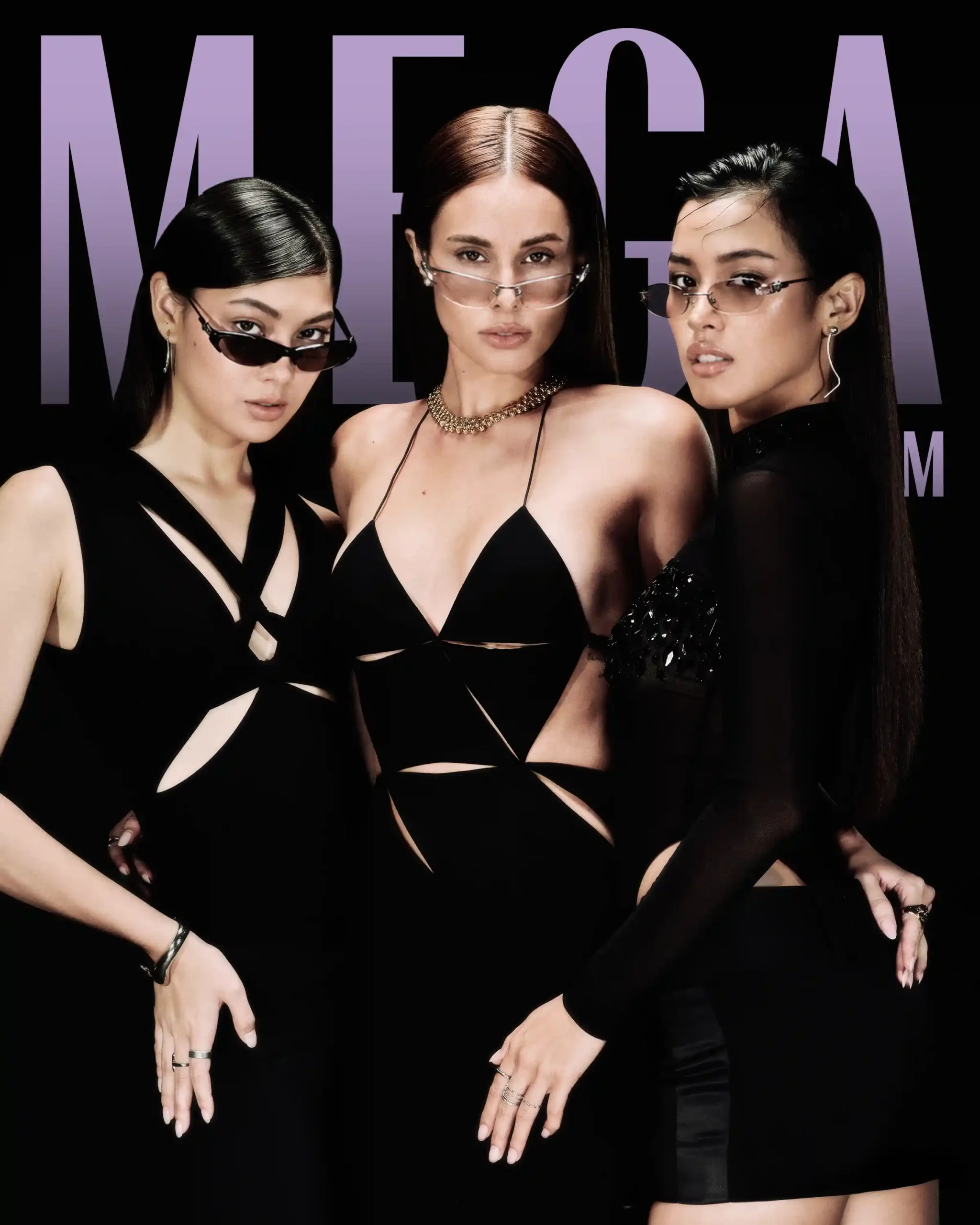
That truth lingered throughout MEGA’s cover shoot inside a studio in Pasig City. Charlie Fleming, Shuvee Etrata, and Max Collins could not be more different on paper. They belong to different generations, have taken different paths into the industry, and find themselves at entirely different chapters of their lives. Yet watching them together, those differences quickly faded into the background.

There was no sense of hierarchy, no invisible line separating the industry’s newcomer from its more established names. They celebrated one another’s photos, exchanged compliments with complete sincerity, and slipped into conversation with the ease of sisters who simply enjoyed being in the same room. It was refreshing to witness, especially in an industry so often framed through rivalry. If the leading lady was once imagined as a singular figure standing at the center of the spotlight, Charlie, Shuvee, and Max offered another perspective: that there is room for many women to lead, and that they shine brightest when they aren’t afraid to celebrate one another’s light.
The three currently star alongside Dingdong Dantes in GMA’s action-drama series The Master Cutter, but this story isn’t about the characters they play. It’s about the women behind them. At different ages and different stages of their lives, Charlie, Shuvee, and Max are each asking a different question about ambition, identity, confidence, and growth. Their answers aren’t the same, nor should they be. Their journeys don’t mirror one another, nor should they. Together, they reveal that today’s leading lady isn’t defined by a single path, but by the freedom to write her own.

Charlie Fleming: Owning Her Voice
Charlie Fleming laughs often. She answers quickly. Sometimes she catches herself halfway through a thought, circles back, and somehow arrives at an answer that’s wiser than where she started. It’s a refreshing contradiction. At 17, she possesses the kind of self-awareness people often spend decades trying to cultivate.

Ask her what freedom feels like, and she doesn’t talk about fame, success, or even independence. She talks about something much simpler.
“I really do feel the freedom,” she tells MEGA. “I think it’s because of the people I’m with, the people I’m working with. They have a lot of respect for me. Even if I’m so young, even if I’m 17, even if I have a lot of opinions, wants, and needs, they understand me instead of judging me.”
Then she pauses before landing on what feels like the real answer: “I think that’s the key. The freedom that you need to achieve, or the freedom that you want to achieve, is knowing yourself, knowing your worth, knowing what you’re doing.”
Knowing yourself: it’s a phrase she returns to throughout our conversation, almost instinctively. The more we talk, the more it becomes clear that Charlie’s confidence isn’t performative. It isn’t the loud certainty often mistaken for self-assurance. It comes from someone who has had to grow up earlier than most.

Her entry into entertainment wasn’t born from childhood dreams of becoming an actress. It began during the pandemic, when work disappeared, and uncertainty settled into homes across the country.
“I was crying for a job at 13 years old,” she recalls. “I really thought to myself, I can’t work at a fast-food restaurant. What job could I do?” TikTok became that opportunity. Live streaming helped her earn money, and then a manager discovered her. An online audition eventually led her to Sparkle. Looking back, she still sounds amazed by how quickly everything unfolded.
“I never thought that I would become an artist because I’m from Cagayan de Oro,” she says. “The opportunities for things like this were super, super rare.”

What’s striking is that Charlie still speaks about the industry with remarkable honesty. She loves creating. She loves acting. She loves content creation. But unlike many young artists eager to paint a perfect picture, she’s comfortable admitting that her relationship with show business is complicated.
“My relationship with the industry is like every relationship,” she says with a smile. “It’s not perfect.”
She doesn’t hesitate when asked what makes it difficult.
“I love playing characters, I love exploring but what’s really scaring me in the industry are the people that I’m surrounded with. They say showbiz is scary, and it’s true…there are people who will power-trip you, that’s what’s really stopping me from loving this industry one hundred percent. But the arts? The arts I love.”
Charlie Fleming
It’s an answer that perfectly captures Charlie. Honest enough to acknowledge the flaws, optimistic enough not to let them define her.
That outlook extends far beyond her career. At one point, Charlie describes herself using a familiar Filipino phrase: namulat nang maaga.
“It sounds cliché,” she laughs, “but that’s me.”
The stories behind those words are deeply personal, but what stays with me isn’t what happened to her. It’s how she chose to respond.

“I think it’s the way I responded to life that makes me different,” she says. “I refuse to be a victim. It wasn’t my choice that those things happened to me. But I’ll own it, and I will grow from it.”
Instead of relapsing or feeling down about it, she explains, she wanted those experiences to become “the baseline of where I should be going, which is going up, not going down.” “Because it’s your choice,” she says matter-of-factly. “It’s your choice how you react to the same things.”
That mindset has also shaped how she carries herself in an era where young women are constantly scrutinized. After receiving criticism for being outspoken, Charlie never considered becoming smaller to make other people more comfortable.
“So what if I’m vocal?” she says matter-of-factly. Then comes another sentence that feels deceptively simple: “People should be proud of young women who own their voice.”


To her, speaking up isn’t extraordinary. “It’s the bare minimum,” she says. “Respect doesn’t matter how old you are—respect should come naturally. If you don’t own your voice at such a young age, you could get lost in so many different things but when you know yourself, you know your foundation.”
That same philosophy explains why comparison has never interested her. “It’s happening so much recently,” she says. “Comparing one artist to another. It’s almost like it’s the norm. And I hate it.”
When I ask whether she compares herself to other actresses, she smiles. “Of course, I compare in a good way. Like, oh my gosh, she’s such a good actor. I hope I become that good.”
There’s a difference, she explains. “I’ll just push toward the standards that I have. I just want to become the best version of myself. You love it or not.”

Perhaps the most surprising moment comes when I ask whether she sees herself as a leading lady.
Her answer is immediate: “Not yet, of course.”
For Charlie, the title isn’t measured by popularity.
“A leading woman,” she says thoughtfully, “is someone who has mastered her craft.”
Then she laughs softly. “The thought of striving toward being a leading lady is such a wonderful thing. But for who I am at the moment, I don’t think I’m good enough yet. I’d love to master my craft. If it’s for me, it’s for me. If it’s not, then that’s okay.”
It is an unexpectedly humble ending from someone who seems wise far beyond her years. Charlie Fleming isn’t in a rush to become the next leading lady. She’s more interested in becoming the best artist, and the best version of herself, first. Somehow, that feels like the very reason she’s already well on her way.
Shuvee Etrata: The Woman Who Persists
“I believe I hit rock bottom.”
It isn’t the kind of sentence most rising stars would choose to lead with. Yet Shuvee Etrata says it without bitterness, without resentment, and without asking for sympathy. If anything, she sounds strangely at peace with it.

“But if you’re at rock bottom,” she tells MEGA with certainty, “there’s no way but up.”
Last year, as her career began gaining momentum, old social media posts resurfaced online, placing the young actress under intense public scrutiny. It was the kind of controversy capable of overshadowing everything else. For a while, it did. Yet when asked to revisit that chapter, Shuvee spends remarkably little time talking about the backlash itself. Instead, she talks about what it taught her.
“I feel like I really got so lucky,” she says, smiling at a thought that seems almost contradictory. “When I got out of Pinoy Big Brother, all I felt was love. So I feel like God allowed all of that to happen to humble me. To teach me that what He can give, He can also take away.”

She doesn’t pretend it wasn’t painful.
“Yes, I was hurt. Yes, people betrayed me. People turned on me,” she admits. “But it taught me to always stay true to myself. Hindi naman naka-depende sa kanila ang pagkatao ko. Hindi rin naka-depende sa kanila ang worth ko (My character doesn’t depend on them. My worth doesn’t depend on them either).”
What emerges is not a story about controversy, but about perspective. Every setback seems to become an invitation to grow. Every unexpected turn becomes another lesson to carry forward.
That same outlook surfaces when she’s asked how much life has changed over the past year. Instead of talking about career milestones, endorsements, or television projects, Shuvee offers a different answer.
“I’m forever gonna be a sponge,” she says with a laugh. “Absorb lang nang absorb (Just keep absorbing).”
The metaphor feels almost too perfect. Despite everything that has happened, she speaks less like someone celebrating arrival and more like someone embracing the process.

“I feel like there’s always space for improvement,” she tells MEGA. “It’s always nice to humble yourself and take that moment to step back and look at the bigger picture.”
“I’m still in the process of finding the best version of myself. Maybe as an actor. Maybe as a better person. Marami pa akong dapat matutunan at pagdaanan (I still have a lot to learn and go through).“
That willingness to evolve has reshaped more than her career. It has reshaped the dreams she once held.
Growing up, medicine always seemed like the obvious path. “I wanted to pursue medicine because it was the only dream that was put into my mind by my parents,” she recalls. “Living on an island, my viewpoint in life was very limited.”
Today, she no longer sees that dream as something she lost. “My dreams have evolved,” she says simply.

“A perspective I recently gained is to strive for what you’re given. As long as pinaghihirapan ko itong career na ito (I worked hard for this career), I’m going to flourish.”
The entertainment industry may not have been part of the original plan, but it has given her something she never expected.
“I see myself striving and learning. This career has given me security. It has given me money. Pera naman talaga ‘yung importante (Money is truly important). But it’s not just that. It somehow gave me a purpose in life. Even though I’m not saving lives, I am able to change the life of my family, mine, and the people who believe in me.”
Shuvee Etrata
The dream may have changed, but its heart remained the same. The desire to make a difference simply found another way to exist.
That same generosity extends to the people around her.
On the set of The Master Cutter, where she stars alongside Dingdong Dantes, Max Collins, and Charlie Fleming, Shuvee readily admits that sharing scenes with industry veterans can still feel intimidating.
“Especially with Kuya Dingdong,” she laughs. “Tatlong beses akong nagto-toothbrush bago ang eksena (I brushed my teeth three times before the scene).”
Still, nerves never become an excuse. “I always make sure to study my scripts. As professional as you are, you need to know your lines. You need to know your work.”

When the conversation shifts to her covermates, admiration comes naturally.
“These are not just girls,” she says. “These are empowered women.”
Support, after all, is something Shuvee speaks about often. It carried her through her lowest moments, and she believes it has the power to carry other women, too.
“I’m a girls’ girl,” she says. “I love it when girls cheer for me because I feel like only women can fully understand other women.”
What she hopes women stop doing is just as telling. “I don’t like it when someone tells me I’m beautiful while degrading another girl.”
Instead, she hopes women choose affirmation over comparison. “I feel like women should really support each other and affirm each other because that little support could really change the world.”


When the conversation turns to the idea of the modern leading lady, Shuvee’s definition has little to do with status or celebrity. “I’m lucky that we’re no longer male-centered,” she says. “Leading ladies today have the opportunity to just be women… but empowered.”
Throughout the conversation, Shuvee returns to the same words over and over again: learn, grow, improve. They are simple words, but together they reveal someone who understands that success is never a destination; it is a continuous act of becoming. Shuvee is now weathering an industry that celebrates certainty, yet finds strength in remaining teachable. And perhaps that is exactly what allows her to keep moving forward.
Max Collins: The Woman Who Reinvents
For years, the entertainment industry has had a habit of reducing women to a single version of themselves: The sexy one. The young one. The wife. The mother.

As careers evolve, so do the labels. They arrive temporarily, almost imperceptibly, until they begin to feel permanent.
Max Collins has spent enough time in the spotlight to know exactly how easily that happens.
Today, however, she has stopped choosing between the different versions of herself.
“I’ve been in the industry for so long,” she tells MEGA. “I guess now I’m at that point where I know I can be all at the same time.”
It’s a simple realization, but one that reframes her entire journey.
For years, audiences watched her grow through different chapters of her life. They met her as one of television’s most recognizable beauties, watched her become a wife, celebrated her as a mother, and continue to see her evolve as an actress. Somewhere along the way, Max realized she no longer had to let one identity erase another.
When asked who she is today, her answer comes easily.
“I’m a mom, number one, because my son is my priority,” she says. “Then I’d like to call myself an artist because I love my craft. I love producing reels. That’s also a creative aspect for me. And then I’m also an entrepreneur. I have businesses. I really love putting my energy into areas where I can create and evolve.”
There is no hesitation in the way she lists those identities. No apology for wanting more than one life at once. Perhaps that’s because she has learned that balance isn’t something you stumble upon. It’s something you build intentionally.

“I think the reason why I’m able to juggle all the things that I do is that I take care of myself,” she says. “If I don’t, then I won’t do a good job at any of the things I try to do.”
For Max, self-care isn’t an indulgence. It’s discipline. “It’s not just finding time,” she explains. “You really have to make time. I have to make sure I get enough sleep, I take my vitamins… I really try to do my best in whatever I’m doing that day.” Some days, that means being fully present on set.
“If I’m an actress today, I’m going to do my best today as an actress. Other days, it means allowing everything else to wait. “If I’m a mom tomorrow, I’m just going to be a mom that day and focus on my son. I have so many things that require my energy that I have to choose wisely where I put it. It has to be worth my energy. If it’s not, then it’ll take away from my son or from my career.”
Max Collins
It sounds deceptively simple, yet it reveals something many women struggle to give themselves: permission to be fully present wherever they are, without feeling guilty about where they aren’t.
“I have so many things that require my energy that I have to choose wisely where I put it. It has to be worth my energy,” she explains. “If it’s not, then it’ll take away from my son or from my career.”
That clarity extends beyond how she spends her time. It has also shaped the way she sees womanhood itself. Recently, Max pushed back against the long-standing stereotype of the “losyang mom” (“haggard mom”), questioning why motherhood has so often been associated with sacrificing one’s identity.
“For me, it’s kind of insulting,” she says candidly. “Why can’t we say, ‘You look like a hot mom?’ Why can’t that be the norm?”
“Moms have so much to deal with. They carry so much in life that they deserve to be celebrated,” she adds. She pauses before adding what feels like the real point.

“Why can’t the stigma of a mom be that she’s hot? Because we can do everything.”
Challenging that stereotype is ultimately about expanding what women are allowed to be. Mothers can be beautiful. They can be ambitious. They can be sensual. They can build businesses, create art, and still be deeply present for their families. None of those identities have to compete with one another.
Motherhood, if anything, has only deepened her understanding of herself. “I feel like you’ve become more of a woman after having a child,” she says. “Your intuition becomes so much stronger. Being in touch with your emotions… that’s very feminine.”
It has also made her more practical. “I used to say, ‘I’m never going to let my kid use gadgets. I’m never going to ask anyone for help.’ Then you become a mom, and you realize… you need help.”
She laughs: “But your priorities become clearer. That’s when I really became more disciplined.” That sense of certainty also shapes how she navigates an industry where visibility has become constant.

“You really have to be strong and resilient in this industry,” she says. “It comes from having a good foundation, your family, your friends, people who really know you.”
Then she offers another realization: “If you don’t even know yourself, then you’ll let everyone tell you who you are. But if you know yourself, then whatever they say, it’s just noise.”
She knows exactly when that changed. “For me, I learned who I was when I became a mom.”
It’s the clearest answer she gives all afternoon.
The confidence she carries today wasn’t built through public validation. It came through private transformation.
That same generosity follows her onto the set of The Master Cutter. Working alongside Dingdong Dantes once again brought its own pressures, but sharing the experience with Charlie Fleming and Shuvee Etrata became one of the project’s unexpected gifts.
“They’re super humble, caring artists,” she says. “They’re very professional, and it’s so easy to work with them.”
Reflecting on the bond they formed, Max realizes something the three women have in common.

“We’re all breadwinners,” she says. “Maybe that’s why we all have big hearts. We know what it’s like to take care of our families. We care about the people around us.”
Later, when the conversation turns to sisterhood in the industry, she acknowledges that genuine friendships can be difficult to find.
“There are a few genuine gems,” she says. “They’re very hard to find because a lot of the time we’re competing with each other.”
But competition, she believes, is ultimately a choice. “For me personally, I don’t see it as a competition anymore. Matanda na ako. Napagdaanan ko na ‘yun (I’m old. I’ve been through that).“
Instead, she has found something better.
“I love those girls. Charlie and Shuvee are not competitive. They’re very supportive. They’re those rare gems that want to lift you up and want you to feel beautiful.”


Asked what women need to hear more often from one another, Max doesn’t hesitate. “You’re doing great. I’m so proud of you.” Then she adds another thought: “I’ve always been about collaborating because I like giving people their limelight as well. It would be so nice to see more women giving the spotlight to other women, and knowing when it’s your time and when it’s someone else’s.”
It’s a fitting reflection from someone who no longer believes womanhood has to fit neatly into one role or one definition. Max Collins has spent years evolving in public, but perhaps her greatest reinvention isn’t becoming someone new. It’s finally allowing every version of herself to exist at once.
Photographed by JERICK SANCHEZ, assisted by KARL RIMANDO, BUDDY REYES, and DAVE ORPILLA. Sitting Editors: PEEWEE REYES-ISIDRO and SEAN CASTELO III. Creative Direction by PATRICK TY. Art Direction by BRIE VENTURA. Produced by THESSMAR LECTURA. Styled by CATH SOBREVEGA, assisted by KRISTINE LANDINGIN, JUSTINE MENDOZA, and ASHLEY IBASCO. For MAX COLLINS: Makeup by Claui Miranda, Hair by Romel Zausa. For SHUVEE ETRATA: Makeup by ROBBIE PINERA, Hair by JAY WEE . For CHARLIE FLEMING: Makeup by JUSTINE NAVATO, Hair by ROMEL ZAUSA Romel Zausa. Videographed by KIM ANGELA SANTOS of KLIQ.