


This is an excerpt from September 2026 Cover Story
Before feeds, follows, virality and personal branding, there was presence. Anne Curtis, Belle Daza, Georgina Wilson, Solenn Heussaff, and Liz Uy came of age in a world of disposable cameras and physical photo albums, dial-up internet and cable TV, magazine tears and mood boards, landlines and long phone calls. Getting somewhere in your career meant physically showing up.
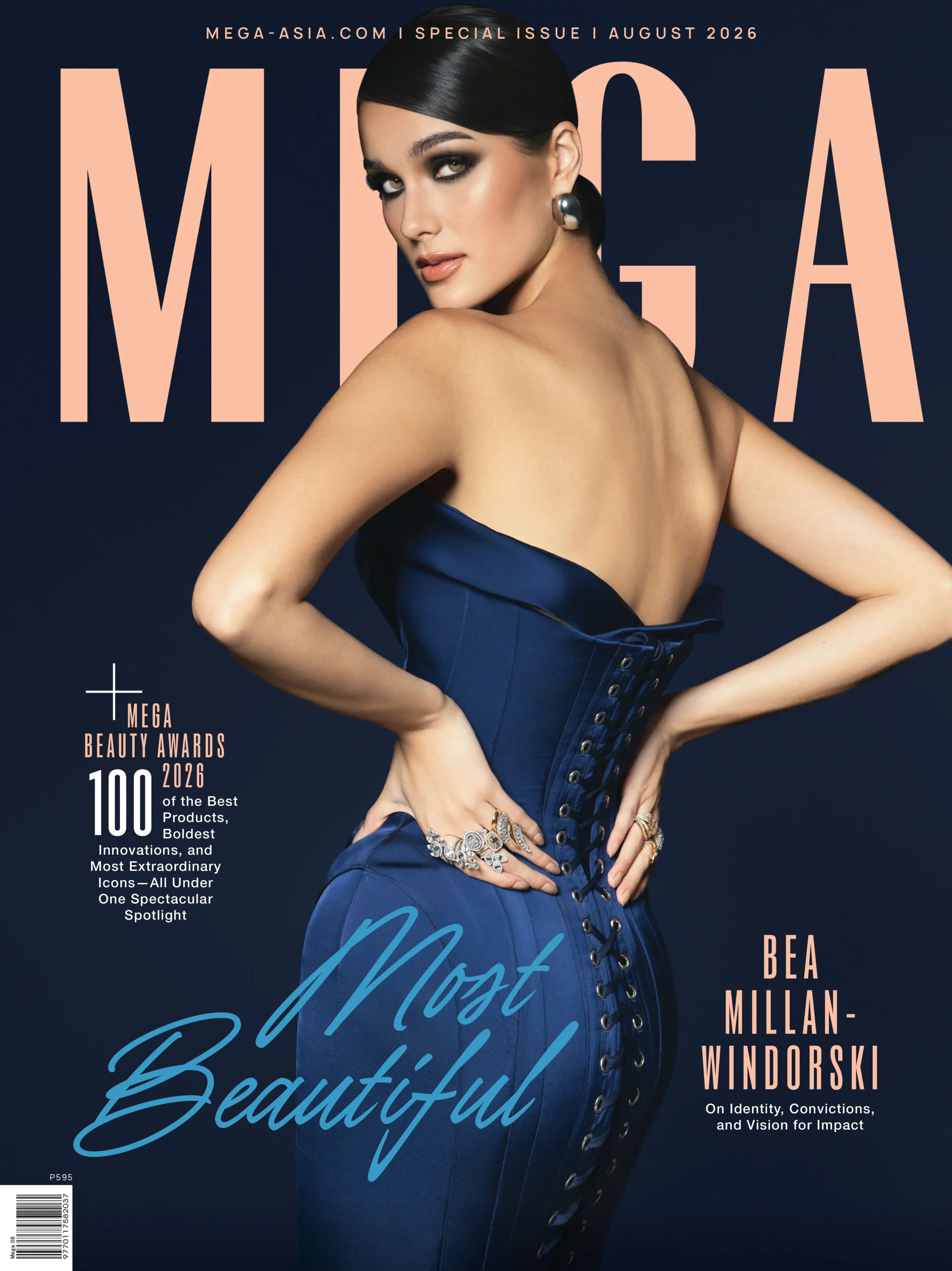
RELATED: Becoming Bea: The Many Layers of a Modern Filipina
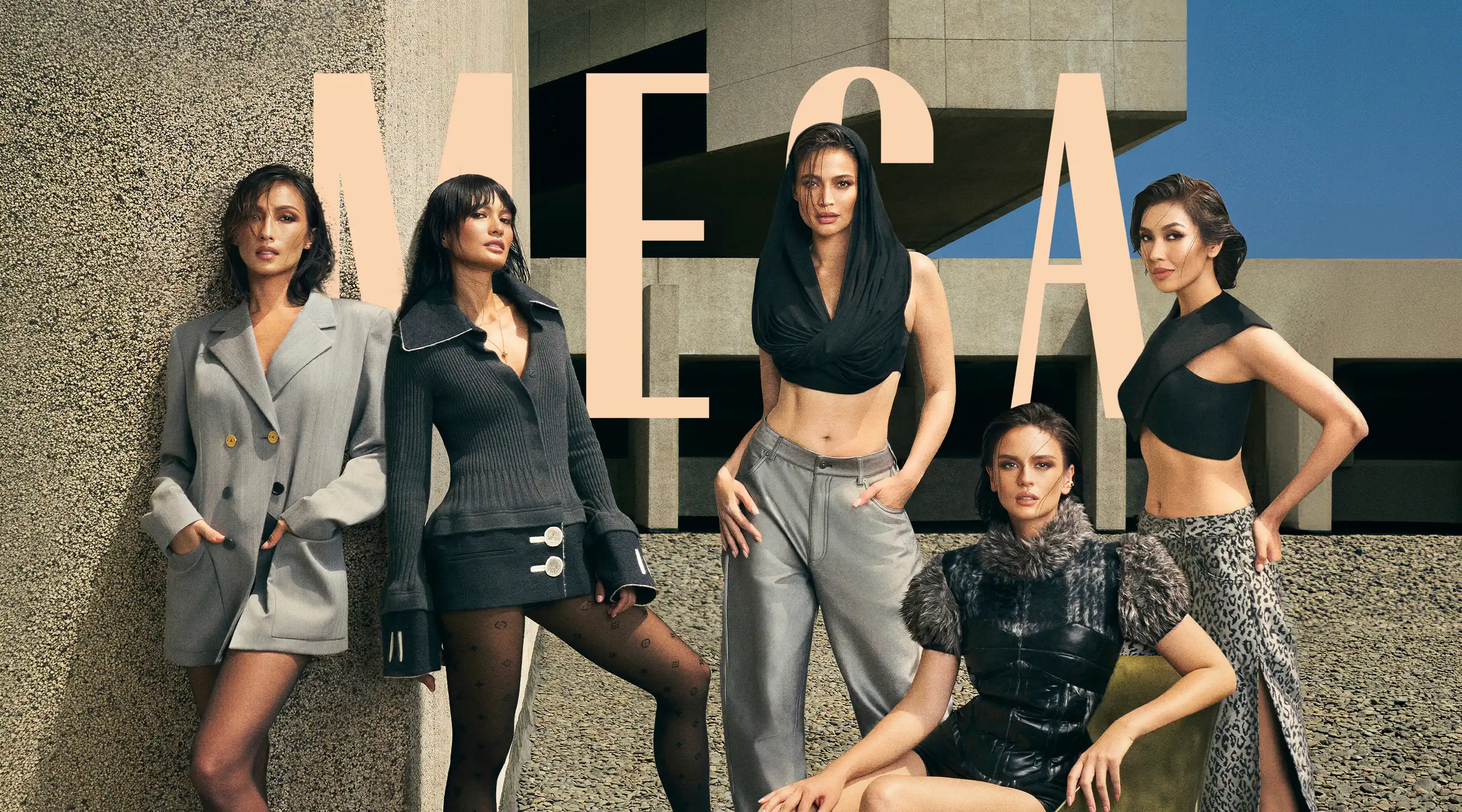
They were among the last generation to experience an analog childhood and the first to master a digital adulthood. Now, together again for a magazine cover shoot—their first joint outing for MEGA. Georgina has flown in from Shanghai, Belle from Geneva, Anne has just wrapped up yet another overseas work trip, and Solenn is moving between travels and projects herself. Liz, with her army of junior stylists in tow, is styling a MEGA cover for the very first time—with an exclusive selection of Louis Vuitton pieces fresh off the runway, anchored by gorgeous iterations of the house’s iconic Capucines.

PUTTING IN THE WORK
If there is one thing growing up analog taught them, it is that nothing happened instantly. There was simply the work itself—and the hours required to get good at it.
For Anne, who started as a commercial model and starred in her first movie at 12, there was no Discover tab or For You page that gave her a start. “It was probably like that slow climb of getting to where you need, where you aspire to be,” she says. In the late ’90s, aspiring models had set cards and had to physically go to VTRs; as an actress, she had to be present for auditions. “It teaches you a lot in terms of patience and determination.”
Belle, who started out as a model, remembers that climb as groundwork—work that could sometimes be invisible to anyone looking at the finished product. “I think the biggest thing that it taught me was having a sense of work ethic,” she says. “People see your highlight reel and the glamour, but they don’t necessarily see the work that came behind it.”
Former VJ and model Georgina remembers the hours, too. She recalls Anne powering through at 7 a.m. for her Sunday noontime show after a night of partying together and Liz starting literally at the entry level of a fashion magazine as an editorial assistant. “I think what’s so important to remember is that you put in the hours,” she says. “You have to put in the hard work.”
The difference, perhaps, is that there was no expectation that success should arrive immediately. “There’s no overnight stardom,” Georgina says. “You really have to just be consistent and show up.”
KNOWING THE DIFFERENCE
Liz knows the labor required firsthand. She remembers taping the soles of pulled-out footwear and ordering food for an entire shoot herself. Her advice is as blunt as the experience: “Know that you got to do all the dirty work.”
For Solenn, who entered the industry as a make-up artist and part-time model, the value of growing up analog was not only in the work but in the pace of life around it. “People appreciated things more back then. Less in a rush, more present,” she says.

That slower pace also gave them room to grow. “I feel like we were able to make more mistakes and not get punished for it,” Solenn adds.
Belle sees another difference in the way people formed their identities. Before the internet became an omnipresent audience, she says, she was able to develop a sense of self. “I gained self-esteem, I think, because I didn’t always read what other people thought of me,” she says. “So I was able to find my true self.”
That doesn’t mean they have rejected the digital world. Quite the opposite: all five have adapted to it, built businesses within it, communicated through it, and found new ways to create. What they have carried with them, consciously or otherwise, is an understanding that a digital presence is only one part of an identity.
“It’s very tricky because we [as a people] have gained the habit of posting everything that we feel and every single thought that comes to our head,” Belle says. “But there’s a discipline also in not posting things.”
Liz understands this perhaps most clearly. She pauses on the distinction between what is shared and what is real. “Not everything we post on social media is really our whole life, it’s not your whole identity.”
For Belle, growing up without the expectation to document everything meant learning how to be present. “Being present,” she says, is one of the things the analog world taught her that the digital one cannot. “Being grateful for what’s happening in the moment and not feeling like I have to take a photo and post about it.”
Yet there is no bitterness about the world that replaced it. If anything, there is curiosity. Georgina is quick to acknowledge that younger creators have skills her generation never had. She watches the way young creators utilize TikTok and admits, “I couldn’t shoot or edit like that!”
But when younger creators ask her how to build a career with staying power, her advice remains grounded in the physical world: “Just get any job, whatever it is. You’ll learn so much just by having a job.”
For Belle, followers are only useful if there is something meaningful behind them. “Going viral isn’t necessarily the pinnacle of success,” she says. “What can you add? What value can you create for your audience?”

PLAYING THE LONG GAME
That may be the clearest lesson this group of accomplished, multidisciplinary women can share after living through both worlds: the tools have changed, but the fundamentals haven’t.
Work still takes work. Taste still requires discernment. Relationships still need presence. A career still benefits from patience. And a private life remains valuable precisely because not everything needs to be seen.
They have each taken those lessons somewhere different. Georgina turned visibility into a business. Belle turned it into a platform for conversations, causes, and communities. Liz turned taste into a career that stretches from fashion to food. Anne, as the whole country knows, turned longevity into its own kind of superpower. Solenn turned inward, making art and returning to acting on her own terms.
Their lives today are as digital as they can get. But the foundations remain decidedly human: grounded in work, discipline, relationships, and real life.
They still show up. They still put in the hours. They still know that a body of work is built one job, one project, one relationship at a time. And perhaps most importantly, they understand that a life does not have to be entirely visible to be meaningful.
They came of age before the world learned to quantify attention. They have since learned how to navigate a world where it is everywhere. But what they haven’t forgotten is that attracting attention is not the same thing as having substance. And after all these years, that may be the most enduring thing they’ve built.
Anne Curtis: The Superstar
From appearing in her first movie at age 12 to becoming the closest we have to a national princess, Anne Curtis has spent most of her life in motion. Pre-motherhood, she says, “I was a workaholic. I loved what I did.”
Then life asked her to stop.
Anne was away for nearly three years, and even when she returned to the Philippines, she wasn’t immediately back at work. “I probably won’t be getting much work anymore when I return. And that was okay,” she remembers thinking. Instead, the pause gave her something that an uninterrupted career could not: perspective. Motherhood became her priority, and returning to work became a conscious choice rather than an automatic next step.

Coming back to It’s Showtime after more than two years away meant relearning her rhythm. “I had that sense of insecurity. It felt so different. So in the first few episodes I felt slow.” For the upcoming thriller BuyBust: The Undesirables, she trained for six months and even asked director Erik Matti for an acting refresher.
That willingness to start again may be one of Anne’s greatest strengths. “I’m a continuous work in progress,” she says. “It’s not about chasing this or that. It’s just really about self-improvement and enjoying what I’m passionate about and wanting to continuously keep learning about it.”
Now, every professional decision is weighed against the life she has built away from work. “I’m at that point in my life where whatever I accept now has to be worth the time away from my family.” Having her daughter Dahlia changed the equation.
The superstar is no longer interested in simply being everywhere. She wants the work to be worth showing up for—and the life outside it to be worth coming home to.
Isabelle Daza: The Connector
Belle Daza has always seemed to exist between worlds. Manila and Hong Kong. Entertainment and entrepreneurship. The public eye and a deliberately private family life. But perhaps her most meaningful evolution has been discovering that a platform is most useful when it extends beyond the person standing on it.
“I love supporting causes that resonate very close to my heart,” Belle says. Among those closest to it are yayas, helpers, and OFWs, people she feels are often taken for granted despite how much they contribute to everyday life. She created a children’s book about her own yaya and even worked on a Kasambahay contract after being told by a lawyer that “no one’s gonna need that.” Her response was simple: “It protects them and it protects us.”

That instinct to connect is also evident in her work with Filipino entrepreneurs and MSMEs through DTI’s Asenso Pilipino. Meeting business owners whose products may be excellent but lack awareness has shifted how Belle thinks about success. “But now, as I’ve grown older, success is many different things.” It can be doing something you love, spending time with family, or simply having peace of mind.
The stories of the entrepreneurs she meets have reinforced that perspective. “They all work so hard and they all have a vision,” she says. Belle has tried to amplify them through digital platforms and, just as importantly, word of mouth. Influence, in this context, becomes less about being seen and more about making sure someone else gets seen.
That same impulse informs the conversations she has built around women’s wellness and sexual health. “Education is power,” Belle says. “When we give people the tools and the resources to understand their bodies better, then they make better choices.”
Perhaps that is what makes her a connector now: she knows how to move between spaces without losing sight of the people in each.
Solenn Heussaff: The Artist
Solenn Heussaff has always had many ways of making things. Before she became known for acting, she was a make-up artist and part-time model. Later came television, fashion design, and increasingly, painting. The difference now is that she no longer feels compelled to decide which one defines her.
For years, her life was built around movement: sets, events, shoots, and saying yes to the next thing. Then she became a wife and mother, slowed down, and discovered what quiet could make possible. “When I slowed down after giving birth to my first, I realized how much I needed that quiet,” she says. It gave her space to observe, to be present with her family, and to understand what she wanted to create.
She doesn’t look back at her showbiz years with regret. “I wouldn’t trade my experience in showbiz for anything,” she says. “I have been able to do the things I want to do today thanks to me showing up and being professional with my past work.”

That difference has created room for a long-held dream: an art school inspired by the “home studio” she attended as a child. “Now I actually have the time and experience to work towards that goal.”
Painting has become the place where those accumulated experiences can exist without needing to be explained. “I get to sit with my feelings without having to explain them.”
In a world where so much is manufactured for consumption, that honesty has become increasingly important to her. “As an artist, it is important to paint something that is real because in the world we live in today, we don’t get much of that.”
“I have always been someone who has to make things,” she says. “Now I just say I am a creative person and creativity will take different forms at different stages of my life, and I’ll just take it.”
Liz Uy: The Tastemaker
Liz Uy has spent more than two decades developing an eye—and, more importantly, learning how to trust it. From editing to styling, from building the aptly named Stylized to creating capsule collections for megabrands and founding healthy snack brand Mood Food, her career has been a study in taste as something that is not simply inherited, but cultivated through exposure, experience, and constant curiosity.
“You start with environment and the people around you,” Liz says. Her own taste was shaped early by brother Vince, whom she credits with exquisite taste, then sharpened through years of experience. Travel expanded it. The creatives she worked with refined it. And, unexpectedly, so have her sons. “I’ve also learned from my kids,” she says. “Never wanting to stop learning. I think that’s so important.”
That may be the key to understanding Liz’s staying power. Taste, for her, is not a fixed set of preferences. It evolves. It absorbs. It edits. It pays attention.

Stylized has become an extension of that philosophy. The stylists who have emerged from the company are now making names of their own, something she describes with genuine pride. “They are all amazing. And I’m also proud of them.” The common denominator, she believes, is experience. “When you do something for 10,000 hours, you become really good at it.”
Her definition of taste has also become a constant study in discernment. Trends remain fun, but when it comes to quality, she thinks about what lasts. “You have to know your personal style,” she says, and choose pieces that resonate enough to remain meaningful over time.
It is a fitting evolution for someone whose career has always been about knowing what belongs and what does not. At this point, Liz isn’t simply collecting beautiful things or chasing the next trend. She is refining a point of view—and thinking about what is worth passing on.
Georgina Wilson: The Founder
Georgina Wilson has built a career around knowing what people might want next. But after more than a decade of co-building the Sunnies empire, her idea of the future has become less about prediction and more about discernment: knowing what deserves to exist, what adds value, and what is worth keeping.
Sunnies was always meant to become more than eyewear. “We knew it was going to be a lifestyle umbrella of things, but we never knew exactly what,” Georgina says. The expansion came through staying close to the consumer and asking a deceptively simple question: how can everyday life be made better?
The company’s vision, she says, is “beauty in everyday things.” It is an idea that allows for constant evolution without losing its core. “The what changes but the why never does,” she explains. The challenge now is knowing which ideas genuinely add substance in an age of relentless consumerism.

That requires a discerning eye. “What actually still matters? What is actually going to add value to my life? Where is there still utility to find?” she asks. The questions are as relevant to a founder as they are to a consumer.
Georgina is also looking at a generation that has access to more than she ever did. Her Gen Alpha son Archie is already interested in Sunnies products and suggests new ones. “So it’s more collaborative now.” The next generation will be difficult to surprise, she thinks, because they have access to everything—and now AI has entered the mix. “It’s going to be crazy selling to that generation,” she says. “And I think it’s going to be a great challenge.”
Her own definition of luxuryLuxuryrefers to a state of exceptional comfort, elegance, and quality, often characterized by premium craftsmanship, exclusivity, and superior experiences.Go to Luxury Glossary has undergone a similar shift. “You can never replace a human emotion,” she says. “Being human is going to be our best asset because no one can take that away from us.”
Photographed by BJ PASCUAL. Creative Director PATRICK TY. Art Director BRIE VENTURA. Beauty Editor AGOO AZCUNA-BENGZON. Beauty Writer MARA GO. Sittings Editors PEEWEE REYES-ISIDRO and TREI ROVERO. Producers THESSMAR LECTURA, DOLLY CAMANTIGUE, and JASON JULIAN. Accounts Manager JULIANA ZEHETHOFER. Stylists JOLO BARTOLO, JETRHO BARRIET TA, STEPHANIE SATORRE, ASHLEY JAMLANG, BEATRIZE LAGCO OF ST YLIZED STUDIO assisted by KIRSTEN BIANZON, AEA LUGAY, and MAGGIE REYES. Makeup Artists EMMAN MAGPANTAY assisted by NICOLAS MAGPANTAY (BELLE AND LIZ); ROBBIE PINERA assisted by DELVI FLORES (ANNE, GEORGINA, AND SOLENN). Hairstylists CHRISTIAN BOJO assisted by CHRISTINE MAE ARCA (BELLE); NELLY SEBOY (GEORGINA AND SOLENN); DALE MALLARI assisted by KIM REGILME (ANNE); JUSTINE OCAMPO (LIZ). Nails POSH NAILS (BELLE); JOCELYN LA TORRE OF MARK ANGELO HAIR STUDIO-WESTGATE ALABANG (GEORGINA AND SOLENN); CHRISTINE NOELLE ROBLE (ANNE AND LIZ). Photographer’s Management PEARL ACUESTA, ANGEL NADAL, and ANNE GELLA MEJIA. Photographer’s Assistants RICHARD DETITA, DAMIAN ESTRELLIS, BAMBOO SANTOS, JOHN PAUL DELA CRUZ, ABEL SANTOS, and EDMIL SANTOS. Chair from CASA BELLA HOME AND LIVING special thanks to ANN TIRONA. Smoke Machine DARWIN ALCANTARA. Special Thanks to PORTIA CABIAD and JAVIER G. BERENGUER-TESTA OF PHILIPPINE INTERNATIONAL CONVENTION CENTER; JEANGER NAVARRO-PONTI OF LOUIS VUITTON PHILIPPINES. Shot on Location at PHILIPPINE INTERNATIONAL CONVENTION CENTER
Frequently Asked Questions
The Originals are Anne Curtis, Belle Daza, Georgina Wilson, Solenn Heussaff, and Liz Uy, five Filipina icons who came of age in an analog era and built lasting careers across entertainment, fashion, and entrepreneurship.
The cover shoot featured an exclusive selection of Louis Vuitton pieces fresh off the runway, styled by Liz Uy and anchored by iterations of the house’s iconic Capucines bag.
Georgina Wilson co-built the Sunnies empire, which grew from an eyewear brand into a broader lifestyle company centered on the idea of “beauty in everyday things.”
Belle Daza supports causes close to yayas, helpers, and OFWs, including a children’s book about her own yaya and work on a Kasambahay contract, alongside advocacy for Filipino entrepreneurs through DTI’s Asenso Pilipino.
Stylized is Liz Uy’s styling company, which has become an extension of her philosophy on taste as something cultivated through exposure and experience, with many of its stylists going on to build their own careers.

Owen Maddela
Owen Maddela is a writer, editor, producer, and former publisher who serves as Head of Content for the Creative Services Team at One MEGA Group - Asia. Since 2005, his work has spanned the intersections of art and commerce through editorial and branded content across magazines, newspapers, books, websites, social media, and trade expositions.
A keen observer of fashion, culture, food, the arts, design, and entertainment, his tenure in media and wide-ranging interests have shaped a writing style that traces the connections between history, trends, and pop culture. He currently leads branded content for MEGA while continuing to contribute editorial work, with bylines appearing in MEGA, Vogue Philippines, and VMAN Southeast Asia.
A Marketing graduate of De La Salle University, he has also worked in corporate communications and public relations, informing his approach to storytelling and brand-building.